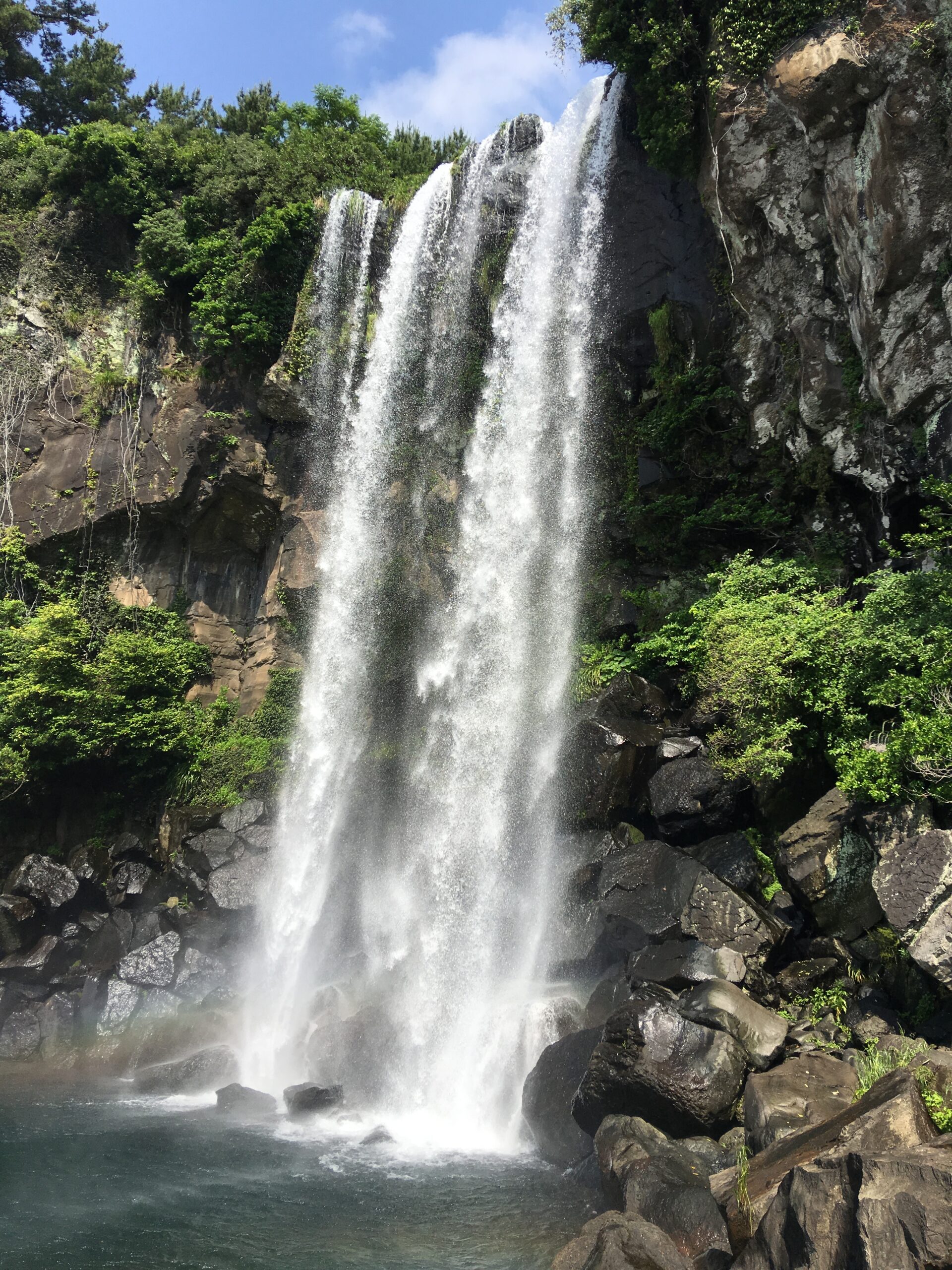
Featured photo: Jeongbang Falls, Seogwipo. Badara25.ba / Wikimedia Commons, CC BY-SA 3.0. Resized for display.
Jeongbang Falls is one of the easiest major natural sights to add to a Seogwipo day because it sits close to the city rather than deep in the mountains. VisitJeju describes it as the only waterfall in Korea that falls directly into the sea, which is what makes the view different from Jeju’s other famous waterfalls.
Why Jeongbang feels different
The experience is less about a long forest walk and more about the meeting point of cliff, waterfall and ocean. From the lower viewing area, the water drops from the dark volcanic cliff toward the rocky coast, so the sea becomes part of the composition instead of merely a background.
Jeongbang vs Cheonjiyeon vs Cheonjeyeon
| Waterfall | Best for |
|---|---|
| Jeongbang | Ocean-and-waterfall scenery near central Seogwipo |
| Cheonjiyeon | An easier landscaped walk close to downtown Seogwipo |
| Cheonjeyeon | A multi-stage waterfall route in the Jungmun area |
If you have only a short Seogwipo visit, Jeongbang and Cheonjiyeon are easier to combine geographically than adding Cheonjeyeon in Jungmun.
How much time to allow
Allow roughly 45–75 minutes for a normal visit, depending on crowds and how much time you spend near the lower rocks. This is a planning estimate, not an official time limit. The attraction can be shorter than a full hiking stop but still requires more than a quick roadside photo.
Wear shoes for uneven, wet ground
The final coastal area is rocky and can be slippery. Shoes with decent grip are more useful than sandals with smooth soles. After rain or during rough weather, follow staff barriers and local safety instructions rather than trying to reach a preferred photo point.
Best way to combine it
Jeongbang fits naturally with central Seogwipo sights, the Maeil Olle Market area and Cheonjiyeon Falls. If you are already following a downtown route, it is more efficient than driving across Jeju for another single attraction.
For a broader city route, see our Downtown Seogwipo One-Day Itinerary.
When to skip it
- You have mobility limitations that make uneven rock access uncomfortable.
- Heavy rain or strong coastal weather affects safe access.
- Your day is already based in eastern Jeju and would require a long cross-island detour.
Plan the approach, the climb back and your next stop
Put the Korean name 정방폭포 into your map before leaving your hotel. Jeongbang, Cheonjiyeon and Cheonjeyeon are different attractions, and the similar English spellings can produce the wrong destination in a hurried search. Check the pin against the coastline near central Seogwipo. Save the entrance as well as your next destination so you can work out the complete outing instead of navigating only to the waterfall symbol.
A taxi or car journey ends at an access point above the coast; it does not remove the descent to the viewing area. Treat the visit as two separate physical tasks: getting down to see the waterfall and returning uphill afterwards. A route that seems easy on arrival may feel different in humid weather or after several earlier sightseeing stops. Leave the less mobile person in your party enough time to make an independent decision at the entrance.
If you travel by bus, check the final walk from the actual stop rather than assuming that a stop with a familiar district name is beside the attraction. Compare the full door-to-door journey, including the wait, walking approach and return stop. For a small group, a short taxi connection may be worth considering when it removes an awkward last section; obtain the current estimate from your booking service instead of relying on a fixed fare quoted in an old travel article.
Our Jeju bus guide explains the wider transport system. For this particular outing, a useful method is to plan the outward trip and one reliable return option before you start. Download or save the place name and hotel address if your mobile connection is uncertain. A screenshot of a bus timetable is a fallback reference, not a substitute for checking service changes on the day.
Travel light. A small bag that leaves both hands free is easier to manage than shopping bags, a large shoulder bag or a suitcase. Wear shoes you are comfortable climbing in, secure your phone before moving across uneven ground, and stop in a stable place before taking a photograph. Spray and damp surfaces are part of the coastal setting. Waterproof phone protection can be useful, but it should not encourage you to move beyond a barrier or toward a wave-exposed edge.
For families, agree on a stopping point and keep the adults close to children during the descent and return. A stroller-friendly street approach does not establish that the final waterfall viewpoint is stroller-accessible. Ask staff about the current route and where a stroller can appropriately be left; do not plan to carry it down a crowded staircase simply because the entrance was easy to reach. Visitors who need step-free access should confirm suitable viewing options directly before purchasing admission.
The visit estimate above is for the attraction itself. It does not include collecting a rental car, searching for parking, a bus wait, lunch or the next transfer. If you have a timed booking afterwards, work backward from that commitment and keep a separate travel buffer. A simple two-stop afternoon is usually more resilient than an itinerary whose every gap assumes immediate transport and no queues.
Choose a realistic Seogwipo half day
Example: waterfall first, market afterwards. Start with Jeongbang while your group has the energy for the steps. Afterwards, move toward the downtown area for a meal and the market rather than adding another distant natural attraction. This order gives you a natural point to rest and makes it easier to shorten the day if the weather changes. The example is a suggested planning sequence, not an official tour or a promise about transport times.
Example: two waterfalls with different experiences. If waterfalls are the main reason for your visit, compare Jeongbang with Cheonjiyeon instead of treating them as interchangeable. The first offers a coast-facing setting; the second offers a different approach and landscaped surroundings. Plan a proper transfer between them and decide whether a second admission and another walk add enough value for your group. Seeing two attractions well is preferable to arriving at a third shortly before its last entry.
Example: a short stop from a Jungmun base. Jeongbang can be part of a dedicated downtown Seogwipo outing, but it adds movement to a day already centered on Jungmun. Read our Jungmun one-day route before combining the two areas. Choose which area matters most and remove a lower-priority stop; do not keep adding places while leaving every original time allowance unchanged.
Check opening information, last admission, ticket categories and any closure notice immediately before departure. These are separate questions: a published closing time does not necessarily mean visitors can enter until that minute. This guide does not freeze an unverified ticket price or last-entry time into the itinerary. The official tourism source below provides the attraction context, while current on-site notices determine what is accessible on the day.
Good photographs do not require standing closest to the water. First find a safe place with room for other visitors to pass, then frame the cliff and coast together. If a particular angle is crowded, wait from a wider area rather than stopping on steps. Avoid photographing strangers at close range without permission. Weather can change the waterfall’s appearance, so judge your visit by the setting and experience rather than trying to recreate a photograph taken in another season.
In rain, distinguish between disappointing photography and unsafe access. Light cloud may change the view, but a closed path or staff restriction changes whether you should enter. If access is restricted, use the time for a downtown meal or an indoor stop whose opening status you have checked. Keep refundable or flexible plans where possible. A waterfall trip is more enjoyable when the rest of the day can absorb a delay or cancellation without creating pressure to ignore local instructions.
Before leaving your accommodation, confirm five things together: the correct waterfall pin, a suitable walking route for everyone, current entrance information, a workable return connection and one flexible next stop. This small preparation step solves most of the practical problems that a photograph alone cannot reveal.
FAQ
Is Jeongbang Falls in Jungmun?
No. It is near central Seogwipo. Cheonjeyeon Falls is the major waterfall associated with the Jungmun area.
Can I combine Jeongbang and Cheonjiyeon?
Yes. They are both in the Seogwipo area and work well in the same half day if current access and your pace allow.
Do I need hiking gear?
No technical hiking equipment is needed for a standard visit, but stable footwear is useful because the coastal rocks can be uneven and wet.
Official source
VisitJeju waterfall guide: official VisitJeju information
Bottom line: choose Jeongbang when you want a distinctive waterfall close to Seogwipo without building an entire hiking day around it.