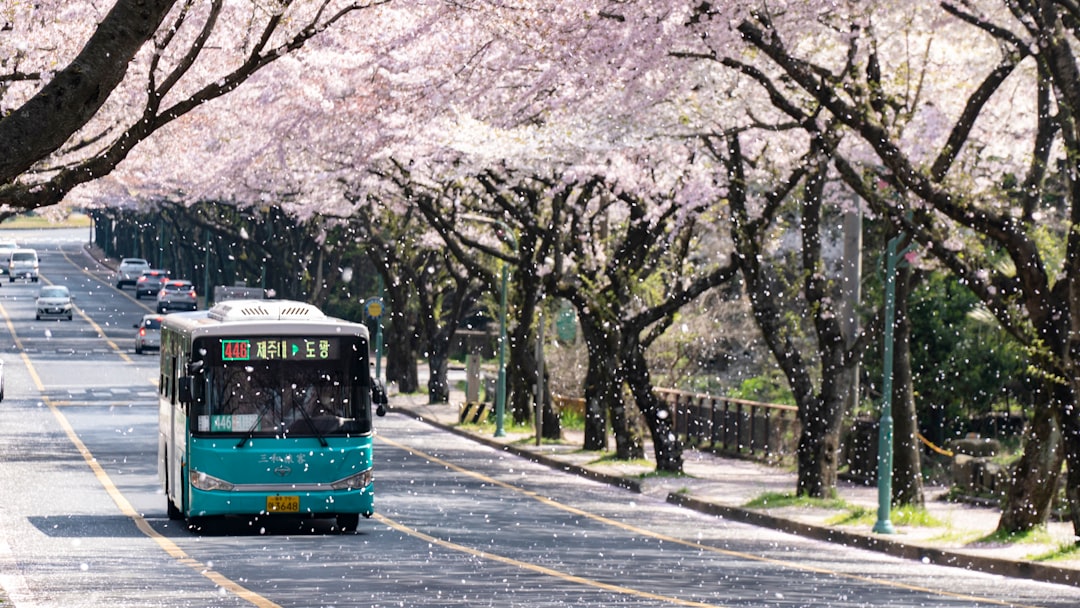
Featured photo: Jeju local bus 446 beneath cherry trees; bus types and routes vary. Photo by Ji Seongkwang (source), Unsplash License. Resized for display.
Jeju is possible to explore by public bus, but it is much easier when you understand how the island’s routes are organized before you arrive. This guide explains the system in practical terms for foreign travelers, including which buses matter most, how fares work, how to use a transportation card, and how to plan realistic routes.
Last verified: September 2026. Bus routes and timetables can change, so check the official Jeju Bus Information System before travel.
Quick Answer: Is Jeju Easy to Travel by Bus?
Yes, especially if you stay in Jeju City, Seogwipo, Seongsan or another area with frequent service. The main challenge is not ticketing—it is distance. Jeju attractions are spread across a large island, so trying to cross from east to west several times in one day can waste hours.
If you do not plan to rent a car, start with our Jeju Island Without a Car guide.
How Jeju Bus Routes Are Organized
Jeju’s official bus system groups routes by type. The categories most useful to visitors are express buses, trunk buses, city and local buses, tourist circulation buses and airport limousine routes.
- 100-series: express services that connect major areas more quickly.
- 200-series: trunk routes that are useful for coastal travel and intermediate stops.
- 810 and 820: tourist circulation routes serving selected attractions in eastern and western Jeju.
- 600/601 and 800/801: airport limousine-style routes connecting the airport with major areas including Jungmun and Seogwipo.
For many visitors, the most useful long-distance routes include buses toward Seongsan and the east coast, west-coast services toward Aewol and Hallim, and airport-to-Seogwipo services.
Bus Fares
For adults, regular trunk and local buses currently cost KRW 1,150 by transportation card or KRW 1,200 in cash. Express buses use distance-based pricing: the transportation-card base fare is KRW 2,000, with a maximum adult fare of KRW 3,000. Airport limousine routes use their own distance-based fare tables.
Because fare rules can change, check the official fare page shortly before your trip.
Use a T-Money or Compatible Transportation Card
A rechargeable transportation card is the easiest option for most visitors. T-money and other compatible cards can be purchased or recharged at many convenience stores. Tap when you board and tap again when you get off.
Tapping off matters because Jeju offers transfer discounts. With a transportation card, eligible transfers are generally available for up to two transfers within 40 minutes after tapping off.
Airport Buses
If your accommodation is in Jungmun or Seogwipo, airport limousine routes can be simpler than combining several local buses. The 600/601 routes serve the Jungmun area, while 800-series services connect the airport and Seogwipo-area stops.
If your hotel is in Jeju City, local city buses or a taxi may be faster depending on the exact neighborhood and your luggage.
Useful Routes for First-Time Visitors
East Jeju
Express and trunk services make the east coast one of the easiest parts of Jeju to explore without a car. Popular stops and nearby areas include Hamdeok, Gimnyeong, Woljeongri, Sehwa and Seongsan.
The 101 express corridor is useful for faster travel along the eastern side, while the 201 trunk route serves more intermediate stops and connects Jeju City, Seongsan and Seogwipo.
West Jeju
The western side can also be explored by bus, but attractions are more dispersed. Aewol, Hallim, Hyeopjae and the southwest require more careful route planning. Group nearby places into one day instead of returning to Jeju City between every stop.
Tourist Circulation Buses
Routes 810 and 820 are designed around clusters of visitor attractions. They can be useful if your planned stops match the route, but they are not a replacement for the entire island bus network.
How to Plan a Bus Day in Jeju
- Choose one region for the day: east, west, south or Jeju City.
- Pick one major destination and one or two nearby secondary stops.
- Check the last practical return bus before leaving your hotel.
- Add extra time for walking between bus stops and attractions.
- Keep a taxi budget for the final short section when bus service is inconvenient.
Best Places to Stay If You Depend on Buses
Jeju City is convenient for the airport and many long-distance routes. Seogwipo is better for southern attractions and can reduce long daily crossings. Seongsan is useful if Udo and eastern Jeju are a priority.
For a full comparison, see our upcoming guide to where to stay in Jeju.
Bus Travel Mistakes to Avoid
- Trying to visit the east and west coasts on the same day.
- Assuming every attraction has a stop directly at its entrance.
- Ignoring the return timetable until late afternoon.
- Relying on cash instead of a transportation card.
- Planning routes with no buffer for weather or missed connections.
Local Jeju Tip
If a route looks simple on a map but requires two or three transfers, compare it with a taxi for the final section. In Jeju, a bus-plus-short-taxi combination is often more practical than insisting on public transport for every kilometer.
Official Sources
FAQ
Can tourists use T-money in Jeju?
Yes. Compatible transportation cards are widely used on Jeju buses.
Do I need to tap when getting off?
Yes. Tapping off is important for correct fare calculation and transfer discounts.
Can I see Jeju without renting a car?
Yes, but the trip works best when you choose regional daily routes and avoid crossing the island repeatedly.
Are buses enough for every attraction?
No. Some rural attractions are easier with a taxi, guided tour or rental car for the final section.