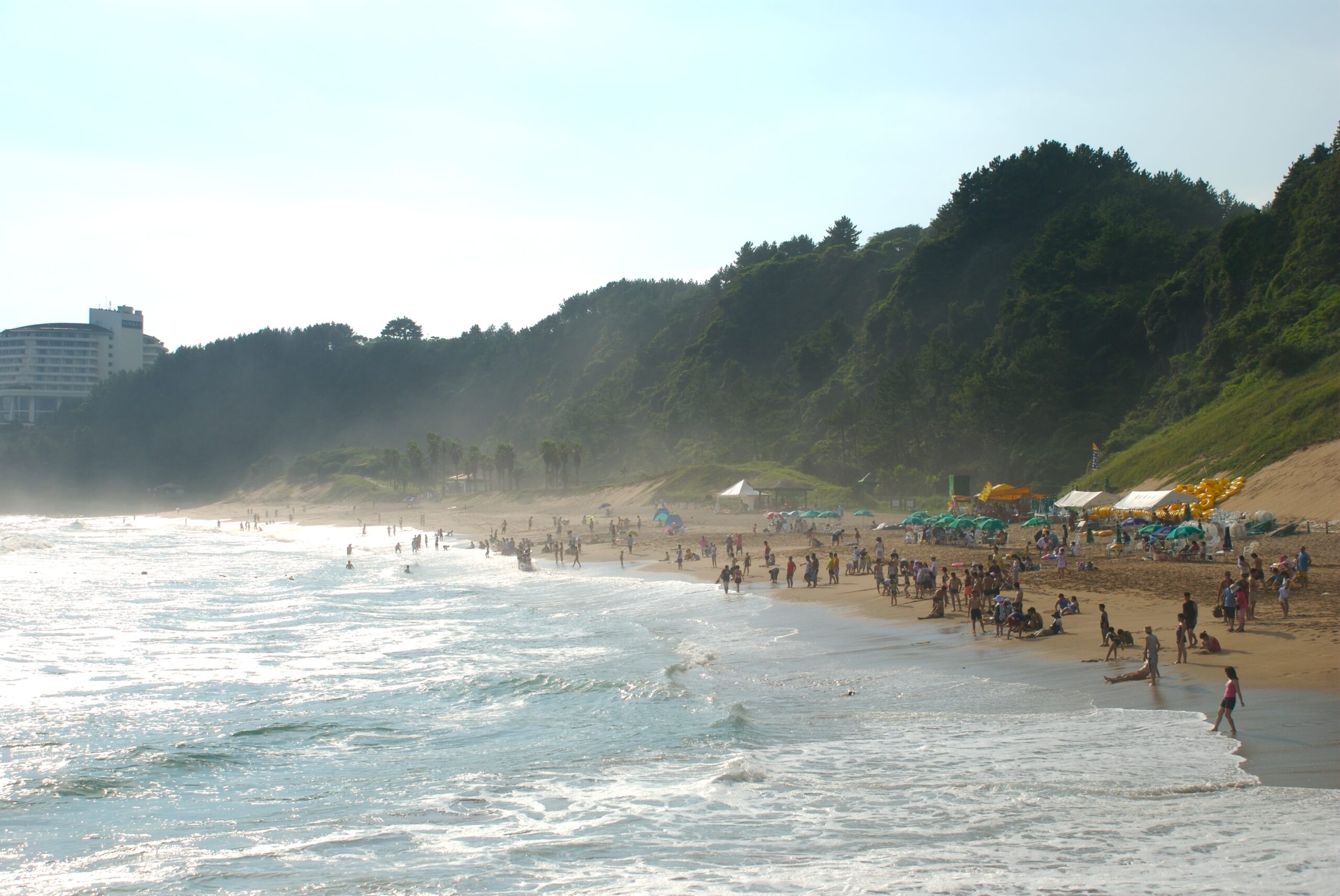
Featured photo: Jungmun beach, southern Jeju. Yoo Chung / Wikimedia Commons, CC BY-SA 3.0. Resized for display.
Choosing where to stay in Jeju is less about finding the ‘best’ hotel area and more about deciding which drives you want to avoid. Two common bases—Jeju City in the north and Jungmun in the southwest—solve very different travel problems.
Jeju City is the practical choice for airport access, restaurants and urban services. Jungmun is a purpose-built tourism area that puts you closer to southwest attractions such as Cheonjeyeon Falls and Daepo Jusangjeolli.
Quick decision table
| Priority | Better base |
|---|---|
| Early flight or late arrival | Jeju City |
| Frequent airport access | Jeju City |
| Southwest Jeju sightseeing | Jungmun |
| Resort-style stay | Jungmun |
| Urban restaurants and errands | Jeju City |
| Cheonjeyeon/Jusangjeolli-focused day | Jungmun |
Stay in Jeju City if airport logistics matter
Jeju International Airport is on the north side of the island, so Jeju City reduces the stress of a late arrival or early departure. It is also useful for short stays when you do not want to spend your first or final hours crossing the island.
The trade-off is that popular southern and southwestern attractions require longer travel from the city. If most of your sightseeing is around Seogwipo, staying north every night creates repeated cross-island driving.
Stay in Jungmun if your trip is built around southwest Jeju
Jungmun Tourist Complex concentrates hotels, restaurants and attractions in a visitor-oriented zone. VisitJeju’s official waterfall guide places Cheonjeyeon Falls here, and Daepo Jusangjeolli is nearby, making the area efficient for travelers who want a slower resort base with major sights close together.
The trade-off is airport distance. Do not book Jungmun for the final night if a very early flight would make the transfer stressful unless you have a transport plan you trust.
What about Seogwipo downtown?
Central Seogwipo is a third option and can be better than either choice for travelers who want markets, local restaurants and city access to southern attractions. Jungmun is more resort-oriented; downtown Seogwipo feels more like a working city. If those differences matter, compare all three rather than treating the south as one area.
Split stays can work—but only on longer trips
For four or five nights, changing hotels once can reduce backtracking: spend the first part in Jeju City or the east, then move south. For a two-night trip, changing hotels often creates more packing and check-in friction than the saved driving is worth.
A simple rule by trip length
- 1–2 nights: choose one base based on your highest-priority sights.
- 3–4 nights: one base still works if your itinerary stays mostly on one half of the island.
- 5+ nights: consider splitting north/east and south/west to reduce repeated driving.
Rental car or no car?
Without a rental car, base choice matters even more. Jeju City has the broadest urban transport connections, while Jungmun is convenient once you are inside the resort area but can require more planning for distant attractions. Check current bus routes and travel times for your exact hotel before booking.
Compare the complete stay, not just the room rate
A useful accommodation comparison includes four costs: the room, airport transfers, everyday sightseeing transport and the time you lose moving between them. A cheaper room is not necessarily a cheaper trip if it creates an extra long transfer every day. Conversely, a resort price may buy facilities you will barely use if you plan to leave early each morning and return after dinner. Start with the days you actually want, then judge the accommodation against that plan.
For a first night after a late arrival, prioritize a straightforward check-in and a reliable way to reach the property. Confirm the reception arrangements and the exact address, particularly for small guesthouses. Do not assume a hotel described as being in Jeju City is a short walk from the airport, or that a property marketed under Jungmun is inside the central tourism complex. Area names are broad; the map pin and arrival instructions are more useful than the listing headline.
For the last night before an early flight, work backward from the airline’s required arrival time. Add the actual transfer, a realistic margin and, if relevant, the rental-car return process. Compare that total with the transport available from each hotel at the hour you need. This is where an airport-side final night can be valuable even for a traveler who prefers Jungmun for the rest of the stay. The decision depends on your flight and transport plan, not on a universal rule that everyone must sleep in the north.
If you rent a car, check parking availability, the property’s parking conditions and whether luggage drop-off is easy. If you do not, check the walking route to the bus stop, the services you will actually use and the cost of short taxi gaps. A stop on a map does not prove that the desired route serves it in both directions. Read our Jeju bus guide before treating an accommodation listing’s phrase “near public transport” as sufficient detail.
Meals also shape the experience. Look at what is available near the hotel when you expect to eat, rather than counting every restaurant within the wider district. A family returning tired from a day out may value a simple meal within walking distance more than a famous restaurant across the island. For a resort stay, check whether breakfast or another meal is included and compare the total price for everyone traveling, not just the base room rate.
Keep room configuration separate from location. Two properties in the same area may have very different beds, family occupancy limits, bathroom layouts or cancellation terms. Verify those details on the booking page before using the neighborhood comparison to make the final choice. A convenient base cannot compensate for a room that does not comfortably fit your group.
Test your base against two sample itineraries
Example A: two nights with a late arrival and a north-coast day. A Jeju City base often makes practical sense because the first evening and departure logistics matter a great deal in such a short stay. Keep the full sightseeing day focused on one region. You can still visit the south, but decide whether the transfer is worth giving up time near the airport side. This is an itinerary example, not a claim that every north-coast sight has a direct bus from every city hotel.
Example B: four nights with two southwest sightseeing days and a resort afternoon. Jungmun becomes a stronger choice because the things you want to do cluster around that base. Use one day for the waterfall and cliff area, another for a carefully chosen southwest route, and keep the resort time you are paying for. If the departure flight is early, compare staying put with moving north for the final night. Include packing, checkout and another check-in in the calculation.
A split stay only helps when it removes more friction than it introduces. Before booking two hotels, list which suitcase-moving day will change and where your luggage can go between checkout and check-in. Avoid making that same day your most ambitious sightseeing day. If the accommodation change saves little actual traveling, one base and a simpler route can be the more comfortable choice.
For a car-free traveler, draw the day as a chain: hotel to first stop, first stop to second stop, meal, then return. Check the difficult segment rather than only the easiest one. You may find that a Jungmun hotel works very well for a concentrated local day but poorly for repeated eastern trips, or that a Jeju City base is convenient for arrivals yet adds too much travel to a southern itinerary.
Central Seogwipo remains worth comparing if markets, everyday restaurants and a downtown atmosphere matter more than resort facilities. Our Jeju City versus Seogwipo guide explains that broader choice, while the Jungmun one-day itinerary shows what a focused day from a resort-area base can look like.
Finally, read recent information for the exact property and reconfirm any service on which your choice depends. A shuttle, luggage-storage arrangement or late checkout mentioned in an old review is not automatically part of your booking. Write down your three highest priorities before comparing prices; that makes it easier to reject an attractive room that would force the rest of the trip into the wrong shape.
FAQ
Is Jeju City better for a first trip?
Not automatically. It is better for airport convenience, but a traveler spending most days in southern Jeju may waste time commuting from the north.
Is Jungmun only for expensive resorts?
No. The area is known for resorts, but accommodation types and prices vary. Compare current options rather than assuming every property is luxury-priced.
Can I visit eastern Jeju from Jungmun?
Yes, but repeated east-coast days from Jungmun create long travel. If Seongsan and the northeast are major priorities, choose a different or split base.
Official sources
VisitJeju waterfall guide for Jungmun and southern Jeju geography: VisitJeju
Jeju International Airport official site: Korea Airports Corporation
Bottom line: choose Jeju City to minimize airport friction; choose Jungmun to minimize southwest sightseeing friction. The best base is the one that removes the drives your itinerary would otherwise repeat.