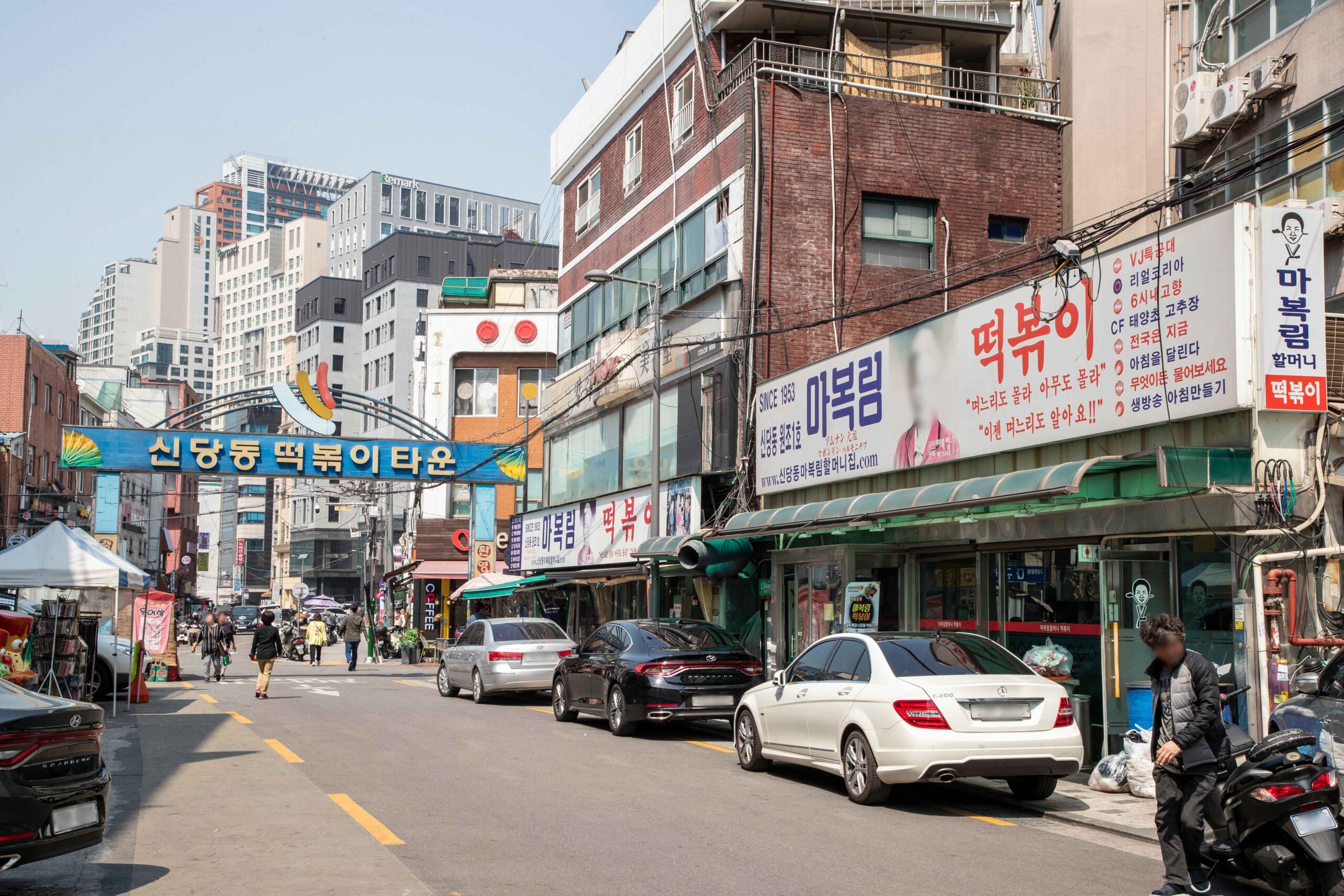
Sindang-dong Tteokbokki Town is a useful stop for travelers who want to understand that Korean tteokbokki is not just one dish. The version most visitors first meet at street stalls is usually served ready to eat in a thick red sauce. Sindang’s signature style is jeukseok tteokbokki: ingredients arrive in a wide pan and cook at your table, turning the meal into something closer to a casual hot pot.
Seoul’s official tourism guide describes Sindang-dong Tteokbokki Town as a representative food alley and links its history to Ma Bok-rim, whose restaurant dates to 1953. The official listing also places the alley a short walk from Sindang Station and notes that individual restaurants keep different hours.
What makes Sindang tteokbokki different?
The base still includes rice cakes and a spicy-sweet sauce, but a Sindang meal is usually built around a pan that can contain fish cake, cabbage, boiled egg, dumplings and ramyeon noodles. Restaurants may offer seafood, jjajang-style black bean sauce or hotter variations.
The defining feature is not one exact recipe. It is the table-cooked format. You sit down, order a set for the number of people in your group, and let the ingredients cook together. The starch from the rice cakes and noodles thickens the sauce as the meal progresses.
How to order if you do not speak Korean
Most first-time visitors do not need to assemble the entire pan ingredient by ingredient. Start with the restaurant’s standard set for your party size. Then add extras only if you know you want them.
- Tteok (떡): rice cakes
- Eomuk (어묵): fish cake
- Ramyeon sari (라면사리): instant noodle add-on
- Mand u (만두): dumplings
- Gyeran (계란): egg
- Bokkeumbap (볶음밥): fried rice, often ordered after most of the tteokbokki is finished
A simple phrase such as “two-person set, please” is usually enough to begin. If you are sensitive to heat, ask whether the restaurant has a milder option rather than assuming all red sauces are equally spicy.
Do not skip the final fried rice too early
One of the pleasures of table-cooked dishes in Korea is using the concentrated sauce at the end. If the restaurant offers fried rice, staff may mix rice with the remaining sauce after you have eaten most of the rice cakes and noodles. For two people, ordering too many add-ons at the start can make it hard to reach this final stage.
Which restaurant should you choose?
The official Seoul guide lists several well-known restaurants and identifies Mabongnim Halmeonijip as the historical starting point of the alley. Its official tourism listing says it was established in 1953 and describes the sauce as combining gochujang with chunjang, the black bean paste used in jjajang-style flavors. The listing was edited in July 2026 and gives operating hours of 09:00–22:50, with closures on the second and fourth Monday of each month.
That does not mean every traveler should automatically choose the oldest shop. If one restaurant has a long queue and another has the same table-cooked style with space available, your overall experience may be better by comparing menus, wait time and portion sizes.
How to get there
Visit Seoul lists Tteokbokki Town at 5 Dasan-ro 35-gil in Jung-gu, around a few minutes on foot from Sindang Station on subway lines 2 and 6. The tourism listing currently points travelers toward Exit 8 for the alley, while the Mabongnim restaurant listing references Exit 7. Either way, use the restaurant’s current map pin once you are in the neighborhood rather than relying only on an exit number.
Best time to visit
If the goal is an easy meal rather than nightlife atmosphere, late morning or an off-peak afternoon can be less stressful than a prime dinner period. Because business hours vary by shop, check the specific restaurant before making a special trip.
Sindang can work well as part of a broader central-Seoul food day. If you prefer a cafe-focused neighborhood instead, compare it with our Yeonnam-dong food and cafe walk. The two areas solve different travel needs: Sindang is about a specific shared meal, while Yeonnam is better for slow wandering and multiple stops.
A realistic meal plan for two
- Order the standard two-person tteokbokki set.
- Add one noodle portion only if it is not already included.
- Let the pan come to a proper simmer before eating the rice cakes.
- Try the sauce before adding extra spice.
- If you still have room, finish with fried rice rather than ordering every side dish at the beginning.
Common first-timer mistakes
- Expecting street-stall tteokbokki: this is a sit-down shared meal.
- Ordering too much: noodles, dumplings and fried rice add up quickly.
- Touching the stove constantly: follow the staff’s guidance on heat and timing.
- Assuming one restaurant’s hours apply to the whole alley: they do not.
- Visiting only for social-media hype: the value is in experiencing an older style of Seoul’s tteokbokki culture, not in finding a single ‘best’ bowl.
FAQ
Is Sindang-dong tteokbokki extremely spicy?
Spice level varies by restaurant and recipe. The classic style is spicy-sweet, but some sauces use black bean paste or other ingredients that change the flavor. Ask before adding extra spice.
Can one person eat there?
Some restaurants are built around sets for two or more diners, so solo dining can be less convenient than at a street stall. Check the menu before waiting in line.
Is Mabongnim Halmeonijip the only historic restaurant?
It is the restaurant most directly identified by Seoul’s official tourism guide as the starting point of the alley, but Tteokbokki Town contains multiple restaurants with their own variations.
How much time should I allow?
Allow roughly an hour for a relaxed meal, plus extra time if you visit during a queue-heavy dinner period. This is not a grab-and-go snack stop.
Official sources
Checked September 19, 2026. Restaurant hours and holidays can change, so verify the specific shop before visiting.