Korea’s 2026 autumn colors are forecast to peak nationwide in late October, starting with Seoraksan around October 20 and reaching Hallasan on Jeju around November 6. Those dates come from the Korea Forest Service’s 2026 foliage peak forecast map, published on September 22, 2026. The real advantage for a traveler is knowing how to read the forecast alongside the live mountain reports, because the two official sources define “peak” differently.
This guide is for visitors planning an October or November trip who want to place a mountain, a park or a Jeju day where the color is most likely to be. All dates below were checked on October 2, 2026.
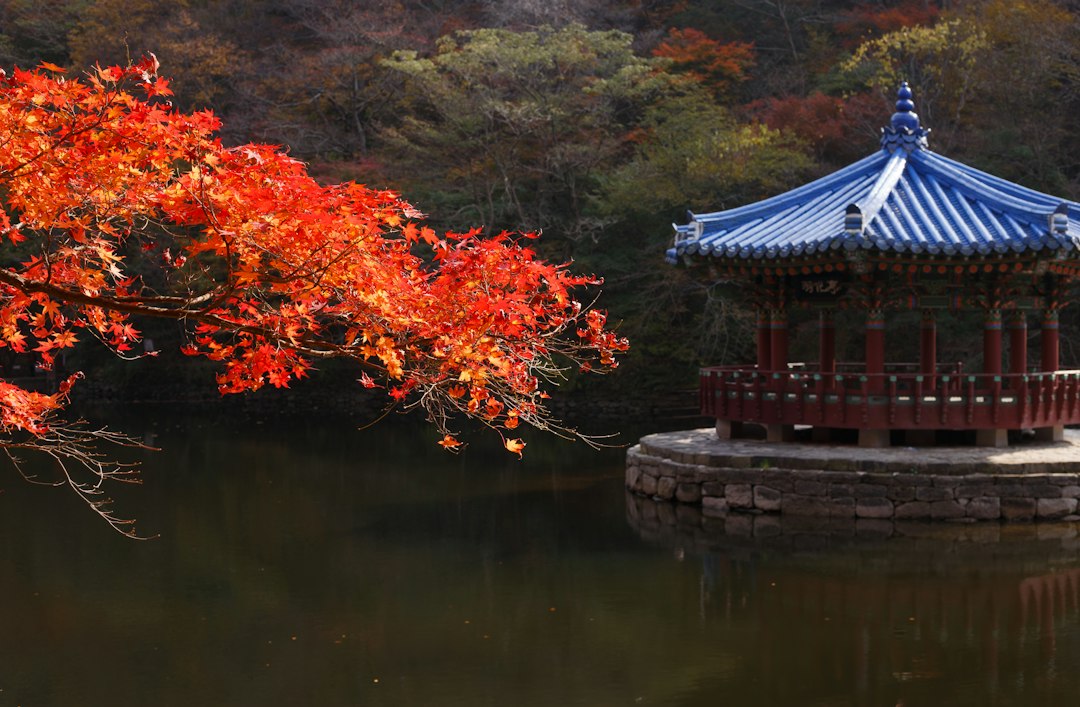
Autumn reference photograph. For current foliage, use the live reports linked below. Photo: Ken Cheung / Unsplash · Unsplash License.
1. The 2026 forecast at a glance
The Korea Forest Service and the Korea National Arboretum build the forecast from plant-phenology observations collected since 2009, combined with mountain weather data from the National Institute of Forest Science. This year’s first autumn color was recorded on September 14 by citizen observers in the Jeombongsan forest genetic resources reserve in Inje, Gangwon. The forecast expects color to spread in earnest from the northern Gangwon mountains in early October and to reach a nationwide peak in late October.
| Mountain or tree type | Forecast peak (Korea Forest Service, 2026) |
|---|---|
| Seoraksan (Gangwon) | October 20 |
| Songnisan (central Korea) | October 28 |
| Naejangsan (southwest) | November 4 |
| Hallasan (Jeju) | November 6 |
| Ginkgo trees | October 30 |
| Maples and oaks | October 31 |
The Forest Service says these dates run about 0.8 days later than the average peak of the past five years. In practice, that means this is a normal-timing year, not an unusually early or late one.
2. Why two official sources give different “peak” dates
You will see foliage news from two government bodies, and they measure different things:
- Korea Forest Service / National Arboretum: “peak” means the leaves are 50% colored, based on tree observations. This is the source for the forecast table above.
- Korea Meteorological Administration (KMA): “first foliage” means about 20% of the mountain is colored from the summit down, and “peak” means about 80%. This is the source for the live reports on famous mountains.
KMA recorded Seoraksan’s first foliage on September 28, 2026, the same as its long-term normal and earlier than last year’s October 2. KMA’s figures put Seoraksan’s normal peak at October 17, while last year’s came on October 24. Because the thresholds differ, a KMA “peak” announcement and the Forest Service forecast will not necessarily match for the same mountain. Treat each mountain’s date as the middle of a window, not a single perfect day.
3. Check one specific place before you book
Since September 29, the National Arboretum has offered an address search for foliage timing. On the Korea Plant Phenology Network site (knpn.nature.go.kr), open the seasonal forecast menu (관측기록 > 계절예측) and enter a road-name address or building name. You will get that location’s estimated peak date, using the same 50% threshold. The search may be Korean-only, so a browser translation tool or copying the Korean address from a map app helps.
This is the most useful tool if your target is a city park, an arboretum or a palace garden rather than a high mountain. The national tree-type dates (ginkgo on October 30, maples and oaks on October 31) are only a general guide for lowland trees.
4. Watch the live reports in the final week
KMA’s Weather Nuri site has a famous-mountain foliage page covering 21 major mountains. For each, it shows photos taken before the color, at first foliage and at peak, laid out on a map. KMA publishes these updates through the autumn season. Check the page two or three days before a mountain day to see whether the forecast is running ahead or behind. On the day before, check the regular KMA forecast for that area, because cold and wind are the main comfort risks on high trails in late autumn.
5. A worked example: one 10-day trip, three foliage zones
Suppose you land in Seoul on October 26 and leave from Jeju on November 7. Using the 2026 forecast as a window:
- Late October, central Korea: Songnisan’s forecast peak (October 28) falls early in the trip. That makes a central-mountain day more realistic than Seoraksan, whose forecast peak (October 20) will already have passed.
- Early November, southwest: Naejangsan’s forecast (November 4) fits the second half of the trip.
- Final days, Jeju: Hallasan’s forecast (November 6) matches the end of the trip. Check our Hallasan hiking reservation guide before planning a summit trail, and use our Jeju autumn guide for lower-effort seasonal stops.
If your trip lands earlier, around October 15–22, the forecast points toward the Gangwon mountains instead. Either way, keep one flexible day so you can move a mountain day forward or back after checking the live reports.
6. Frequently asked questions
Is late October the best time for fall foliage in Korea in 2026?
For the country as a whole, yes. The Forest Service forecasts a nationwide peak in late October. Northern Gangwon comes earlier, while the southwest and Jeju come in early November.
When does Jeju’s autumn color peak?
The 2026 forecast for Hallasan is November 6. Lower parts of the island can differ, so use the address search for a specific location.
The KMA says a mountain has peaked, but the forecast date hasn’t arrived yet. Which is right?
Both can be correct. KMA’s peak means about 80% of the mountain is colored, while the Forest Service forecast uses 50% leaf coloring from tree observations. Use the forecast to plan the week and the KMA photos to fine-tune the day.
Will the forecast dates change?
The forecast map is a prediction published on September 22. Actual timing depends on autumn temperatures, so re-check the live reports close to your visit.
Bottom line
For 2026, plan around Seoraksan near October 20, Songnisan near October 28, Naejangsan near November 4 and Hallasan near November 6. Treat each date as a window, use the Arboretum address search for a specific place, and confirm with KMA’s live mountain photos a few days before you go. For broader season planning, see our Korea in Autumn planning guide.
Official sources checked October 2, 2026: Korea Forest Service press release: 2026 foliage peak forecast map (Korea.kr, September 22, 2026) · KMA Weather Nuri: famous-mountain foliage status · National Arboretum: Korea Plant Phenology Network (seasonal forecast search) · Yonhap: KMA confirms Seoraksan first foliage (September 28, 2026) · Forest news report on the National Arboretum address search service (September 29, 2026)
Foliage dates are forecasts and shift with the weather. Trail access, reservations and park notices are set by each park authority, so check them separately before a mountain day.