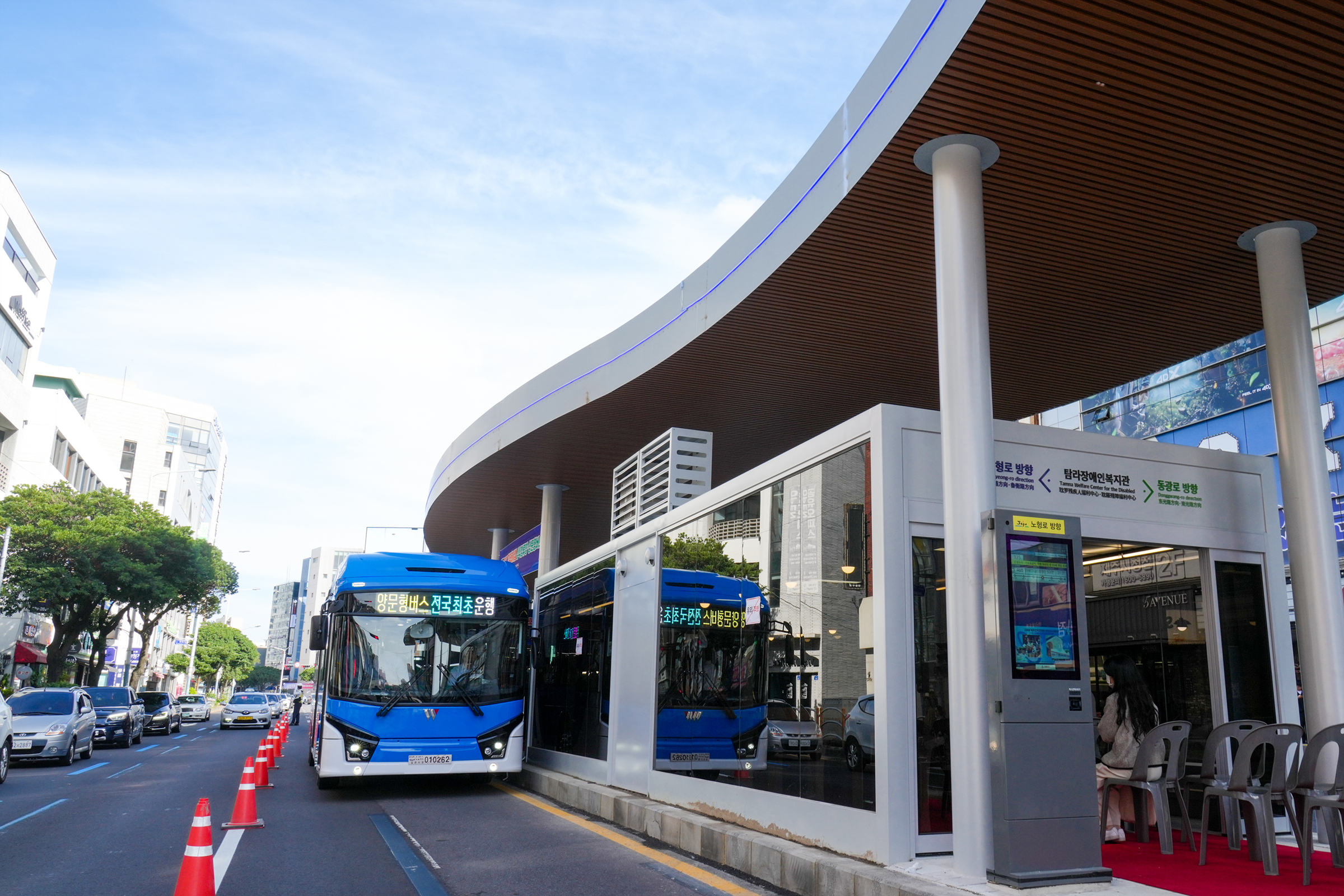
Jeju Bus 240 is one of the island’s most useful routes for travelers who want to see the mid-mountain 1100 Road area without renting a car. The official Jeju Bus Information System lists Route 240 as running from Jeju Bus Terminal through the Eorimok entrance, then toward Jungmun Intersection and the Jeju International Convention Center. That makes it very different from Jeju’s coastal trunk routes: the attraction is the mountain crossing itself.
The route in one sentence
Think of Bus 240 as a north–south mountain connector: Jeju City → 1100 Road → Eorimok area → Jungmun → ICC Jeju. It is useful for Eorimok access, 1100 Road scenery and certain Jungmun trips, but it is not an airport bus and it is not the fastest default route for every hotel in Seogwipo.
Important: it starts from Jeju Bus Terminal, not Jeju Airport
International visitors often see “Jeju City” in a route description and assume the bus starts at the airport. The official route summary identifies Jeju Bus Terminal as the city endpoint. If you land at Jeju Airport, you need to reach a suitable Route 240 stop or transfer first. Check Jeju’s live bus system, Kakao Map or Naver Map on the day rather than copying a transfer from an old blog post.
If you have a large suitcase, think twice before choosing a mountain-route transfer simply because the map looks scenic. Airport limousine routes or direct express buses may be easier for hotel check-in days.
Why travelers use Route 240
- Eorimok access: the route passes the Eorimok entrance area used for Hallasan trails.
- 1100 Road scenery: it crosses one of Jeju’s high-elevation roads.
- Jungmun connection: it continues toward Jungmun and ICC Jeju.
- Car-free mountain day: it can be part of a hiking or scenery plan without driving.
Its main weakness is frequency. A route that is excellent on paper becomes frustrating if you arrive at the stop just after a bus leaves. Always look at the current timetable and live arrival information.
Using Bus 240 for Eorimok
Eorimok is one of Hallasan National Park’s key access points. If your goal is the Eorimok Trail or the short Eoseungsaengak route nearby, Route 240 can reduce the need for a taxi from Jeju City. But mountain hiking requires more planning than simply boarding the bus.
First, check Hallasan National Park’s current trail status and entrance-control times. Weather at elevation can be completely different from Jeju City. Second, check the last practical bus you can use after hiking. A trail that takes “only a few hours” can still leave you waiting in cold weather if you finish after a long gap in service.
Route 240 and Eoseungsaengak
Eoseungsaengak is close to the Eorimok visitor area and is a good option for travelers who want a shorter Hallasan experience. It does not require the summit reservation used for the upper Seongpanak and Gwaneumsa reservation sections under current rules. However, it still has seasonal entry-control times and can close because of weather, ice or safety conditions.
Bus 240 is therefore useful for a “short mountain walk plus 1100 Road” day, but the plan should be built around the mountain first and sightseeing second.
What happens when 1100 Road is closed?
This is the most important 2026 operational detail. Jeju’s official bus system published a July 27, 2026 notice explaining that when the 1100 Road is closed to large vehicles, Route 240 is rerouted. Instead of Jeju Bus Terminal → 1100 Road → Convention Center, the temporary route goes from Jeju Bus Terminal via Pyeonghwa-ro to the convention-center side.
That means a bus can still operate while no longer serving the mountain section you wanted. Never interpret “Route 240 is running” as proof that Eorimok or 1100 Road is accessible. Check both the route notice and road-control status.
Winter and bad-weather planning
The 1100 Road is particularly sensitive to snow, ice and strong weather. On a clear winter day it can be beautiful; during a control period it can become unusable for your intended itinerary. Build a backup plan in Jeju City, Aewol or Jungmun so a road closure does not destroy the entire day.
If your plan is specifically to see snow, do not travel to a closed mountain road just because social media shows snow photos from earlier that morning. Follow official traffic controls and bus notices.
Jeju City to Jungmun: when 240 makes sense
Route 240 can reach the Jungmun side, but it is not automatically the best choice for every Jeju City–Jungmun trip. If your priority is a hotel transfer with luggage, compare direct routes such as airport limousine or other intercity buses. Route 240 is more attractive when the mountain corridor is part of the reason for traveling.
For example, a traveler who checks out of a Jeju City hotel in the morning, takes a short Eoseungsaengak walk, then continues to a Jungmun hotel could use Route 240 as a logical point-to-point route. A traveler landing at the airport at 8 p.m. with two suitcases should probably choose something simpler.
How to read the stop correctly
Korean bus stops often have the same place name in opposite directions. Before boarding, check the destination direction, not just the stop name. At mountain stops, there may be fewer businesses or staff nearby to correct a mistake. Save the Korean destination names and show them to the driver only if needed without delaying boarding.
The route number should be visible on the bus. Tap your transport card when boarding and follow current transfer rules. If you are using cash, be aware that policies can change; a rechargeable Korean transport card is the easier choice for most visitors.
Luggage and comfort
Bus 240 is a normal public bus route, not a dedicated sightseeing coach. Large luggage can be awkward, especially when seats fill or road curves make standing uncomfortable. For a hiking day, carry a compact backpack instead of a rolling suitcase.
Mountain roads can feel more winding than coastal routes. If you are prone to motion sickness, sit facing forward when possible and avoid a heavy meal immediately before boarding.
A realistic car-free mountain day
- Check Hallasan trail status and weather before leaving your hotel.
- Confirm that Route 240 is using the normal 1100 Road alignment, not a weather detour.
- Travel from Jeju City to the Eorimok area early enough to respect trail entry controls.
- Hike Eoseungsaengak or an appropriate Hallasan route based on your fitness and conditions.
- Return to the stop with a generous buffer before the bus you intend to use.
- Continue back to Jeju City or toward Jungmun depending on your accommodation.
Do not confuse Eorimok and the 1100 Highland rest area
The 1100 Road corridor contains several well-known mountain points. Your bus stop needs to match the attraction you actually want. Eorimok is associated with Hallasan trail access; the 1100 Highland area is a different location on the road. Do not get off simply because the scenery looks mountainous.
Use the live map and stop sequence rather than relying on a screenshot of a route diagram.
Best season for Bus 240
There is no single best season. Spring and autumn usually offer comfortable hiking conditions, summer provides green mountain scenery but can bring rain and fog, and winter can offer snow but also the highest risk of road controls. The route is valuable precisely because the landscape changes, but operational reliability changes with it.
What to check before leaving your hotel
- Current Route 240 timetable and live arrival.
- Any Jeju Bus Information System service notice.
- 1100 Road traffic-control status.
- Hallasan National Park trail status and entry-control time.
- Weather at elevation, not only Jeju City temperature.
- Your return bus or onward connection.
FAQ
Does Bus 240 go from Jeju Airport?
The official route summary uses Jeju Bus Terminal as the city endpoint. Airport travelers should plan a transfer or use another route depending on their destination.
Does it stop near Eorimok?
Yes. The official Jeju bus route summary specifically lists the Eorimok entrance on Route 240.
Can I use it when the 1100 Road is closed?
The bus may be rerouted via Pyeonghwa-ro during a 1100 Road closure, which means it can bypass the mountain section. Check the current official notice.
Is it a sightseeing bus?
No. It is a regular public bus that happens to cross a very scenic and useful mountain corridor.
Final advice
Route 240 is excellent when the route itself fits your plan: Eorimok, a short Hallasan experience, 1100 Road or a Jeju City–Jungmun journey that benefits from the mountain crossing. It is less useful when you only want the fastest airport transfer. The difference between a smooth day and a frustrating one is checking the live timetable, mountain weather and 1100 Road status together.
Last verified: September 23, 2026.
Official sources
Jeju Bus Information System: General Bus Routes · 2026 1100 Road Closure Detour Notice · Hallasan National Park Trail Information
Related guide: Hallasan Hiking 2026.