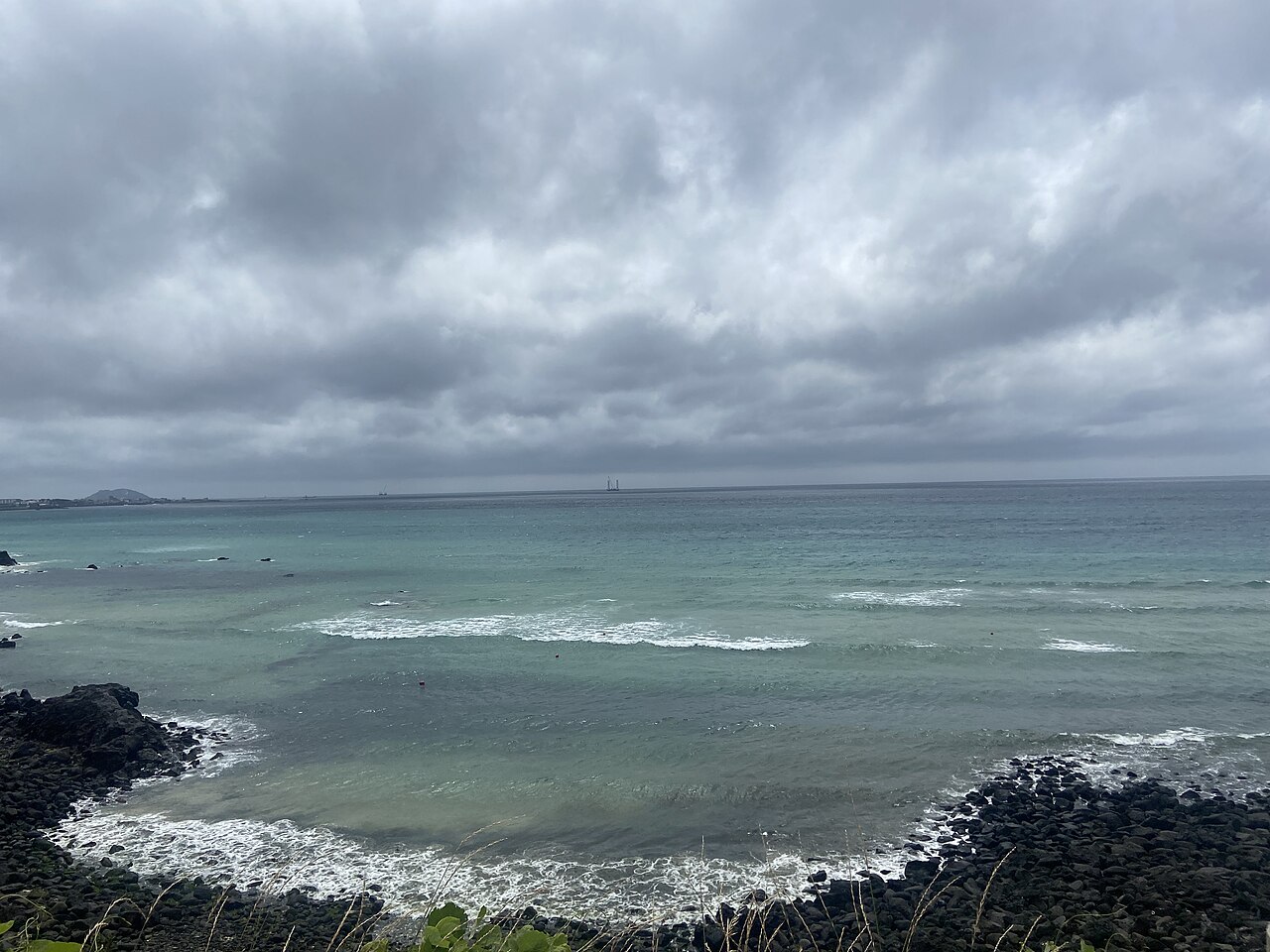
Aewol is not one single stop. It is a long west-coast area stretching across villages, cafés, beaches and the approximately 9 km Hagwi–Aewol Coastal Road. That is why the best bus from Jeju Airport depends on the exact hotel or café you mean by “Aewol.”
Jeju’s official bus system lists Bus 102 as an express west-coast route running through the airport, Aewol, Hallim and Daejeong. The network also lists Bus 202 as a general trunk route along the west coast, useful for more local stops.
Quick answer: check 102 first for a westbound airport-terminal journey when its stopping pattern fits your accommodation. Treat 202 as a local west-coast option requiring a separately verified connection from the airport, not as another bus automatically available outside arrivals. The official route list distinguishes the airport-serving 102 corridor from the 202 corridor starting at Jeju Bus Terminal. The quickest bus segment is not necessarily the easiest complete journey with suitcases.
| Choice | Best reason to check it | What can make it inconvenient |
|---|---|---|
| 102 express | A suitable westbound service from the airport terminal | Your hotel may be far from an express stop |
| 202 local trunk | A local stop closer to the actual destination | You must verify the airport connection and exact service |
| Bus plus taxi | A manageable final leg to an outlying property | Extra cost and taxi availability need checking |
Bus 102: a direct option when the stop fits
Bus 102 is the first route to check if your destination is near one of its express stops. The official schedule identifies it as a route linking Jeju Airport with Aewol, Hallim and the southwest. Express buses stop less frequently and use distance-based fares, so they are not automatically the best choice for a hotel on a small coastal road.
Bus 202: better for more local west-coast stops
Bus 202 runs the west-coast corridor as a general trunk bus. It can be more practical when your accommodation is closer to a local stop than to the 102 express stop. In some cases you may need a transfer from the airport or a short taxi for the final coastal segment.
Why the map pin matters more than the neighborhood name
Aewol-eup is large. A hotel near Hagwi, Aewol Port and Gwakji Beach can all be marketed as “Aewol” while requiring different stops. Before choosing a route:
- Copy the Korean name or exact address of your accommodation.
- Check the nearest stop in the official Jeju Bus Information System.
- Compare 102 with local trunk routes such as 202.
- Check the final walking distance, especially with luggage.
At the airport, make three checks before boarding. First, use the current terminal signs or information desk to locate the westbound stop; a platform number from an old photograph is not reliable confirmation. Second, match the route number and direction with the specific departure you intend to take. Third, show the driver the Korean name of your intended alighting stop, not only the hotel name. 이 정류장에 가나요? means “Does this bus go to this stop?” Keep the destination address available offline in case mobile data fails.
For a 202 connection, verify both legs. Select the exact trip variant and direction in the official stop list. Choose a staffed or otherwise straightforward transfer location with a verified pedestrian route, then confirm how to reach it from the airport. Gonghang-ipgu means Airport Entrance; it is not interchangeable with the passenger-terminal stop. The linked 202-4 page is a dated service example, not proof that every 202 trip follows that pattern or that the same variant operates throughout the day. Do not assume the reverse-direction stop is identical.
Evaluate the final walk. Ask your accommodation which stop it recommends for guests arriving with bags. Check steps, crossings, gradients and the hotel entrance as well as the distance. For a late arrival, ask about check-in before leaving the terminal. If the onward bus has finished or the transfer cannot be verified, consider a quoted taxi journey or changing the first-night plan rather than traveling to an isolated stop without a confirmed connection. This guide does not promise a fixed journey time or a last departure for your travel date.
Current official fares
Jeju’s bus information system currently lists adult card fare for ordinary trunk/branch buses at KRW 1,150. Express buses start at KRW 2,000 by card for the base distance and add distance-based charges. Always tap your transport card when getting off because fare calculation and transfer discounts depend on correct tagging.
The official published fare table gives an adult express card base of KRW 2,000 for 20 km and a maximum of KRW 3,000; cash express travel is charged at the maximum. These are the published fare rules, not a verified fare to every Aewol hotel. A 202 journey may also involve a feeder bus or taxi, so its KRW 1,150 adult card fare is not necessarily the entire airport-to-door cost. Transfer discounts have conditions, and the same-route return should not be assumed free.
Keep your card available for both boarding and alighting, and use a separate transport card per traveler when relying on transfer eligibility. Confirm space for large luggage with the driver and keep aisles clear. Compare the full trip as waiting + riding + transferring + walking. A bus with fewer stops can still lose its advantage if you must wait much longer or walk a difficult final section.
When a taxi is worth it
If two travelers have large luggage and the hotel is several kilometers from the best bus stop, a bus-plus-taxi combination can be more sensible than forcing a long walk along a coastal road. The same is true after dark when pedestrian conditions are harder to judge.
FAQ
Does Bus 102 go through Aewol?
Yes. The current official Jeju bus schedule lists the 102 route through Aewol and Hallim between the airport/Jeju side and the southwest.
Can I take Bus 202 directly from the airport?
Do not plan Bus 202 as a direct pickup at the airport passenger terminal. The official route list identifies the 202 corridor with Jeju Bus Terminal, and listed services such as 202-4 pass Gonghang-ipgu (공항입구, Airport Entrance), which is not the passenger-terminal bus stop. Check Bus 102 for a suitable direct airport service, or use a verified airport connection to a 202 stop. Confirm the exact stop, direction and walking route in the live bus system before transferring; an airport-related stop name does not mean boarding immediately outside baggage claim.
A practical comparison: a hotel near an express stop may work well with 102, whereas a hotel nearer a local 202 stop may justify a transfer. Compare total waiting, transfer and luggage-walking time rather than only the bus’s advertised route. Do not cross airport access roads or follow an unverified shortcut simply because a map pin looks close.
Stop-name verification: official 202 timetable and route and official 202-4 stop list. Fare reference: Jeju Bus Information System fare table.
Where can I verify the route?
Use the Jeju Bus Information System route list and the official fare and route guide. For the destination area, see Visit Jeju’s Aewol Coastal Road page.
Also useful: traveling east instead? Compare our Jeju Airport to Seongsan: 111 vs 101 guide.
Before settling on a stop, compare Hamdeok and Aewol as accommodation bases, and use our Jeju bus guide for travel-card and transfer planning.
Routes and fares checked September 16, 2026. Bus stop patterns and temporary services can change; recheck the official system on your travel date.
Featured photo: Jeong seolah · CC0 1.0 · Wikimedia Commons. Aewol destination photo, not Bus 102 or 202; resized.
