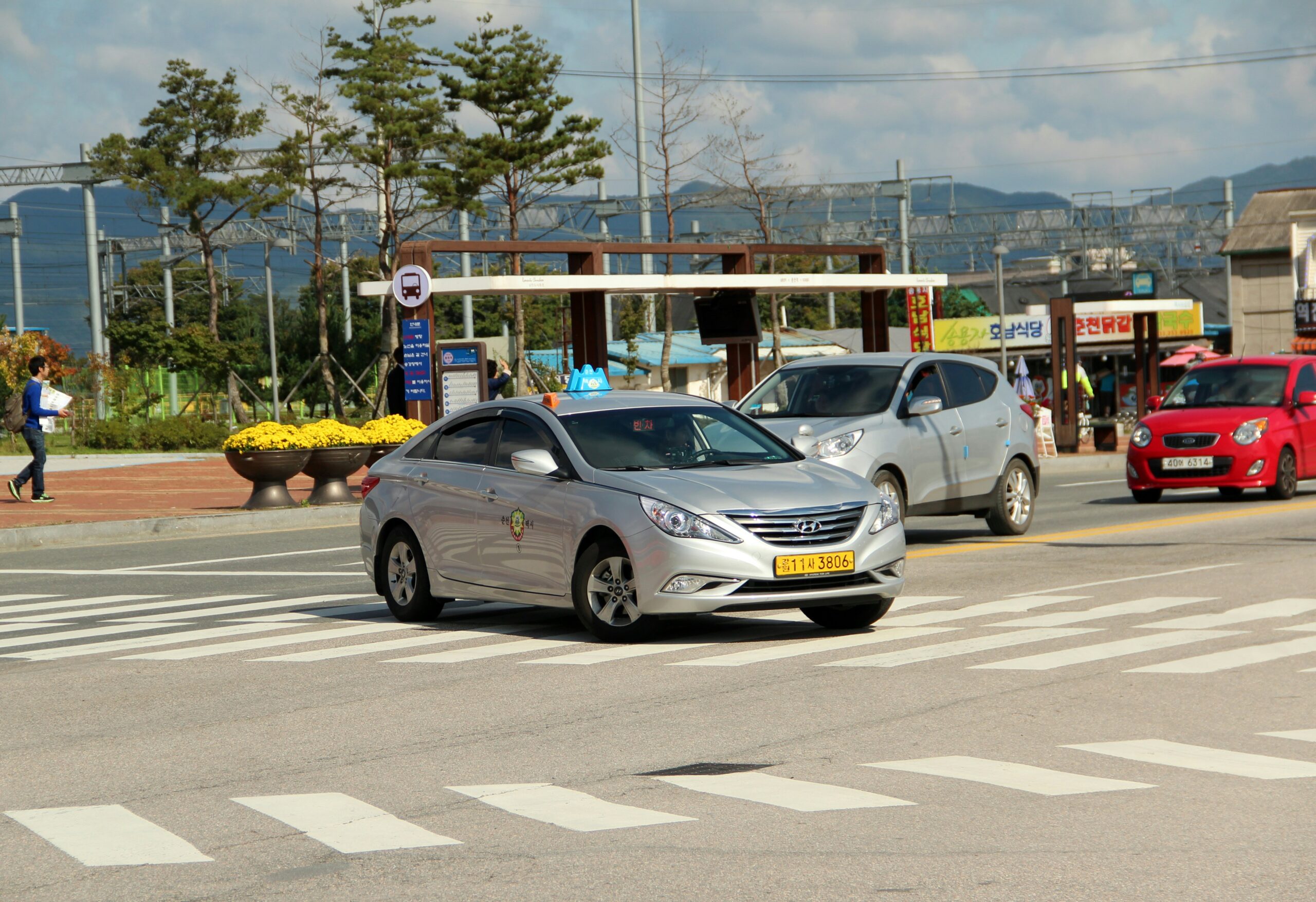
To use a taxi in Korea, prepare the destination in Korean, choose the vehicle and payment method, and keep the trip record. For visitors who prefer an app, the Korea Tourism Organization identifies k.ride and Uber Taxi as options designed to work with overseas travellers. At an airport or major station, an official taxi rank can be easier than trying to match an app driver in a crowded pick-up area.
There is no single nationwide taxi price. The city, vehicle class, time of day, traffic, tolls, and booking service can affect the total. The Seoul figures below apply to the city’s ordinary medium-sized taxi tariff checked on September 21, 2026. They should not be copied into a Jeju, Busan, premium-car, or airport fixed-fare calculation.
Choose the vehicle before comparing prices
A standard taxi is often a practical choice for a short city journey, but a larger group or several large suitcases may need a van or another category. Check passenger and luggage capacity together. A vehicle with enough seats does not necessarily have room for everyone’s bags, and a large vehicle booked through an app can have a different tariff or service charge from an ordinary street-hailed taxi.
Do not identify price solely by the car’s color. Local fleets and vehicle categories vary, and a premium-looking car may belong to a specific service with its own terms. On an app, read the selected category and estimated charge before requesting the ride. At a rank, tell the attendant your passenger count and luggage needs so that you join the correct queue.
For an airport journey, compare the whole trip with rail or an airport bus: walking to the stop, transferring with luggage, the distance from the final station to your hotel, and the number of people sharing the cost. The AREX versus airport bus guide helps with that comparison. A taxi can simplify the final door-to-door journey without necessarily being the cheapest option.
Understand Seoul’s meter and late-night bands
The Seoul Metropolitan Government taxi page lists these starting fares for ordinary medium-sized taxis. Each base covers the first 1.6 kilometres; further distance and low-speed time add to the meter.
| Seoul time | Base fare | Night surcharge |
|---|---|---|
| 04:00–22:00 | ₩4,800 | None |
| 22:00–23:00 | ₩5,800 | 20% |
| 23:00–02:00 | ₩6,700 | 40% |
| 02:00–04:00 | ₩5,800 | 20% |
For the daytime standard tariff, the city lists ₩100 per additional 131 metres and a ₩100 time increment per 30 seconds at low speed. The published threshold for the time component is 15.72 kilometres per hour. This explains why two trips covering a similar distance can cost different amounts when one encounters congestion. Do not treat a map’s straight-line distance as a fare quote.
As a simplified illustration, a five-kilometre daytime journey has 3.4 kilometres beyond the base distance. Using the published distance increments gives roughly ₩7,400 before low-speed time, tolls, or booking charges. This is a teaching example, not a guaranteed five-kilometre price. Use the app estimate or meter for your actual route.
Seoul also publishes an out-of-city surcharge, which can interact with night pricing. Airport and other boundary-crossing journeys deserve a separate check. A deluxe or large-category vehicle uses different fare rules, so confirm the class rather than applying the table automatically. Being a foreign visitor is not itself an extra charge on an ordinary taxi tariff.
Set up an app while you have time and connectivity
The Korea Tourism Organization taxi guide describes k.ride, from Kakao Mobility, as supporting overseas card registration and social sign-in, and notes that visitors can also use Uber Taxi through the Uber app. Features and available vehicle categories can vary by location, so inspect what your account actually offers before relying on it for a time-sensitive ride.
Install the app from its official store listing, sign in, and verify your payment method before an early departure. Make sure the device has mobile data and can receive any required account verification. A hotel Wi-Fi connection can be useful during setup, but the phone also needs to work when you are outside searching for the car or receiving a driver message.
When booking, check the pick-up pin against the side of the road where you are standing. Automatic location detection may place it behind a building or across a divided street. Move the pin to an accessible entrance or legal stopping area, then compare the car’s plate and vehicle details with the app before boarding. Do not enter a car simply because the driver gestures toward you near a busy rank.
Read the payment selection before confirming. If the ride is set to charge the registered card automatically, do not also hand over cash without resolving why another payment is being requested. If you change the destination, update it through the app when possible so the driver and trip record remain aligned. Keep notifications enabled until the journey and payment are complete.
Give an address a driver can use
Save your hotel’s Korean name, road-name address, and a map pin before going out. English hotel names can resemble one another, and a large business may have several branches. A screenshot of a booking page is useful only if the actual address is visible. For a guesthouse down a narrow lane, ask the host for a suitable vehicle drop-off point rather than sending the driver to the centre of the property.
“여기로 가 주세요” means “Please take me here.” Show the Korean address as you say it. “이 주소가 맞나요?” asks whether the address is correct, and “이 입구에서 내려 주세요” means “Please drop me at this entrance.” Use a pin and a short sentence together; a long spoken explanation in English is less useful than a clear destination the driver can read.
For parks, markets, and campuses, choose an entrance on the correct side of the site. A destination covering a large area can leave you with a considerable walk if you select its generic central pin. If meeting friends, agree on the exact entrance before anyone books. This matters particularly at night, when two people can both be “at the park” but several streets apart.
On Jeju, save the destination in Korean even when the English names look distinctive. Cheonjeyeon and Cheonjiyeon are separate waterfalls, for example. A restaurant’s telephone number can also help identify a branch, but check that it belongs to the intended business. If combining taxi and bus travel, use the Jeju bus-stop guide to identify the correct onward stop.
Pay once and keep a useful trip record
Check the final charge and any separately identified toll or service component. Card acceptance is common, but an overseas card can still fail because of the card, terminal, or account setup. Carry an alternative payment method and resolve a failure with the driver before leaving. A rejected transaction and a temporary bank authorization are not necessarily the same thing, so keep the receipt and check the final bank record.
“영수증 주세요” means “Please give me a receipt.” For an app ride, keep the electronic trip record as well. A useful record identifies when you travelled, where the journey began and ended, the vehicle or driver information available, and the amount paid. It helps if you later need to explain a charge or recover a phone left on the seat.
Before opening the door, check the seat, footwell, and luggage area. Have one member of a group count bags while another handles payment. Avoid placing a phone loose on the seat while moving luggage; it is easy to overlook in the final seconds of a trip. Check for passing traffic before getting out and follow the driver’s guidance on a suitable stopping point.
Tipping is not normally expected for an ordinary taxi trip in Korea. If someone quotes an unfamiliar extra amount, ask what it covers rather than assuming it is a standard tip. Keep the exchange calm and refer to the meter, app, or written booking terms. An app’s customer support is the logical first contact for an app-booked payment discrepancy.
Handle late nights, lost items, and disagreements
For a late-night departure, open the app before you leave a comfortable indoor location and inspect available cars. Do not assume a vehicle will appear immediately after a concert or at a remote coastal restaurant. If your hotel is far away, arrange a realistic return plan earlier in the evening. Wait in a visible, lawful pick-up area and keep the group informed of the car details.
If an item is missing, use the app’s lost-item process or the operator information on the receipt. Explain the date, approximate time, route, and item clearly. Avoid publishing the driver’s personal details in a public post while trying to resolve the issue. A precise trip record is more useful than a vague description of the car’s color.
For tourist assistance or help understanding a problem, the Korea Travel Helpline is 1330; from overseas-format dialing, use +82-2-1330. It is a travel assistance channel, not a replacement for emergency services. If a fare remains disputed, keep the evidence and use the relevant platform or local complaint process instead of trying to settle a complicated question in the road.
Finally, choose taxis as one part of your transport plan. The Seoul transport-card comparison helps with routine public transport, while a taxi can fill a late arrival, difficult transfer, or luggage-heavy journey. Knowing the destination, category, payment method, and receipt process removes most of the uncertainty from that final part of the trip.
Photo: Dave Kim / Unsplash original / Unsplash License. Resized by WordPress; no substantive edits.