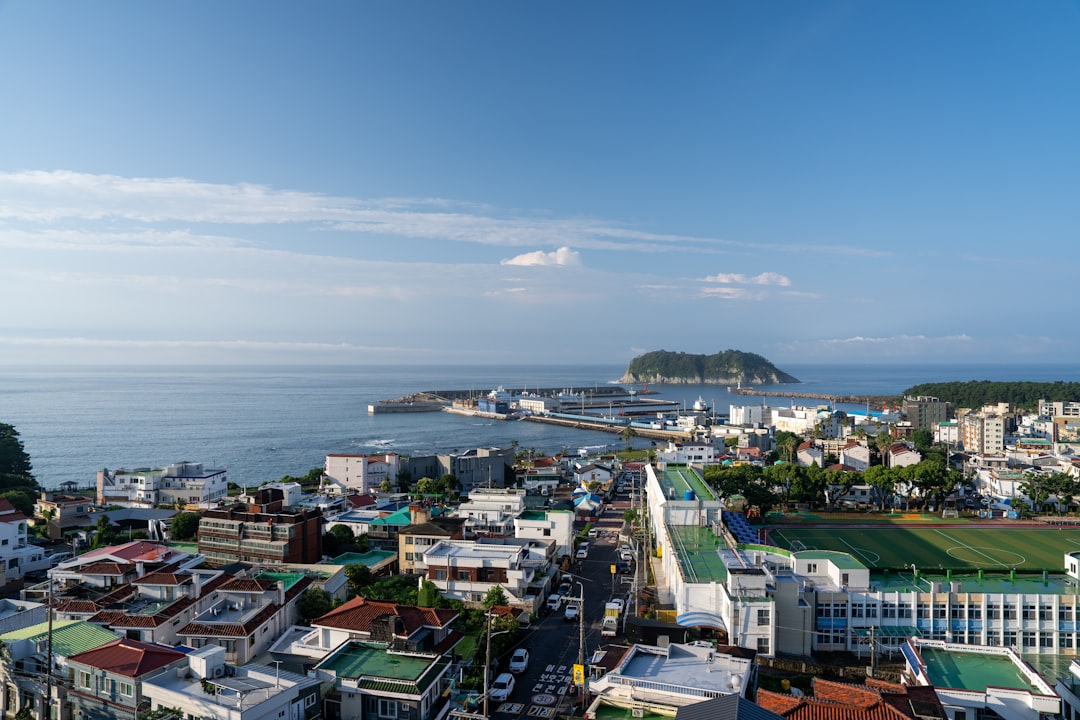
Some K-drama locations are sets built for a single production. Hallim Port is different: it is a working fishing port on Jeju’s west coast that appears as part of everyday island life. That makes it more rewarding for fans who want to understand the setting rather than recreate one exact camera angle.
Why Hallim Port matters to drama fans
Jeju Tourism Organization’s official content guide for When Life Gives You Tangerines includes Hallim Port among the Jeju locations connected to the series. The same harbor landscape is also associated with Our Blues, whose early fish-market and auction atmosphere depends on a believable working-port setting rather than a purpose-built attraction.
The useful expectation is therefore not “a drama museum.” You are visiting a real port where boats, fishery work, auctions and local traffic continue whether a fan is present or not.
What you can see
The visual appeal comes from the harbor itself: fishing boats, breakwaters, low-rise port buildings and the broad west-Jeju coastline. The scene changes with working hours, weather and fishing activity. A location that looked busy in a drama may be quiet when you arrive, and that does not mean you are in the wrong place.
How to visit without disrupting the port
- Stay out of marked work areas and do not block vehicle access.
- Do not photograph workers at close range without permission.
- Keep clear of ropes, unloading zones and wet surfaces near the water.
- Treat fishery facilities as workplaces, not photo props.
This is especially important at active harbors where trucks and equipment can move quickly.
Pair Hallim Port with nearby west-Jeju stops
Hallim Port works best as part of a west-coast day rather than a standalone cross-island trip. Hyeopjae Beach, Geumneung, Hallim Park and the coastal roads of western Jeju are natural pairings. If you are already staying around Aewol or Hallim, the stop is much easier to justify than if you are based in Seongsan.
A fan-friendly half-day plan
- Start with the port in daylight, when it is easiest to understand the landscape.
- Spend only as long as the working environment allows comfortably.
- Move to Hyeopjae or Geumneung for a slower coastal stop.
- Use sunset for the beach or west-coast road rather than waiting at the port for an exact drama shot.
Do you need a car?
A car makes west-Jeju combinations easier, but it is not the only option. Bus routes serve the Hallim area; the key is to check the live route in Naver Map, Kakao Map or Jeju’s bus information service on the day because walking distances from stops can matter more than the raw bus time.
FAQ
Is Hallim Port a dedicated filming attraction?
No. It is an active port. The value for drama fans is seeing a real Jeju environment that productions used as part of their storytelling.
Can I visit at night?
The harbor area itself is not a theme park with fixed tourist hours, but daylight is the better choice for safety, orientation and photography. Working areas may be restricted regardless of time.
Is it worth crossing Jeju only for this location?
Usually not. Pair it with other west-Jeju stops so the day still works even if the exact filming angle is hard to identify.
Hallim Port versus a purpose-built filming set
Fans sometimes arrive expecting signs, props or a marked photo point. Hallim Port is more subtle. The attraction is the continuity between the screen image and the working Jeju landscape: the breakwater, low harbor buildings, fishing boats and the open west coast. That also means the location can look different from the drama depending on tide, weather, parked vehicles and ongoing fishery work.
This is a better stop for travelers who enjoy context. Instead of asking “Where is the exact frame?”, look at how the port connects water, work and nearby town life. That is the visual language both dramas use when they need Jeju to feel lived-in rather than decorative.
Best time of day
Daylight is the clear default. Morning can show more work activity, while later afternoon often gives softer light across the west coast. The exact atmosphere is not guaranteed because port operations follow fishing schedules rather than tourism schedules. If a work area is busy, give workers space and move to a public waterfront viewpoint instead.
Sunset can be beautiful in western Jeju, but Hallim Port itself is not the best place to wait for a long golden-hour session if trucks or fishery activity are moving through the area. Hyeopjae or Geumneung gives you a more relaxed place to spend the final hour of daylight.
A practical west-Jeju route
A balanced route starts with Hallim Port, then moves to Hallim town or Hallim Park, followed by Hyeopjae and Geumneung. This keeps the day geographically compact. If you are continuing farther south toward Sinchang, Panpo or Sanbangsan, treat the port as a short first stop rather than adding it late after several long drives.
Travelers without a car should group stops near the same coastal bus corridor. Waiting for buses can make a “five small stops” itinerary unrealistic, so choose two or three places and allow time for walking from the nearest stop. Jeju’s bus information system, Kakao Map and Naver Map are useful for the live route, but always check the direction of travel because a stop name may appear on both sides of the road.
What to do if you cannot identify the exact filming angle
Do not trespass into fenced or working areas to recreate a shot. Production crews may have used lenses, temporary access, set dressing or camera positions that are not appropriate for visitors. A safe public viewpoint that shows the same harbor context is a better result than an exact composition obtained by interfering with work.
For fan travel, screenshots are useful as visual references, but they are not access permissions. If a location looks private, industrial or restricted, stay in the public area even if the scene appears to have been filmed closer.
What to bring
- Closed or secure shoes rather than slippery sandals near wet harbor surfaces.
- A wind layer; west-coast conditions can feel cooler than inland areas.
- A phone with the location saved in Korean and English.
- A flexible plan in case port operations make one section inconvenient.
Is Hallim Port worth it for non-fans?
Yes, if it fits your route. Non-fans can still appreciate the working harbor and west-coast scenery, but it is not a major standalone attraction with exhibits or visitor facilities. That is why pairing it with beaches, a market stop or Hallim Park creates a stronger day for mixed-interest groups.
Last verified: September 23, 2026. The drama-location connection was checked against Jeju Tourism Organization material. Port access remains subject to real working conditions, safety controls and any local restrictions on the day.
Official source
Visit Jeju: When Life Gives You Tangerines location guide
For a broader fan itinerary, see A Jeju Trip Inspired by When Life Gives You Tangerines.