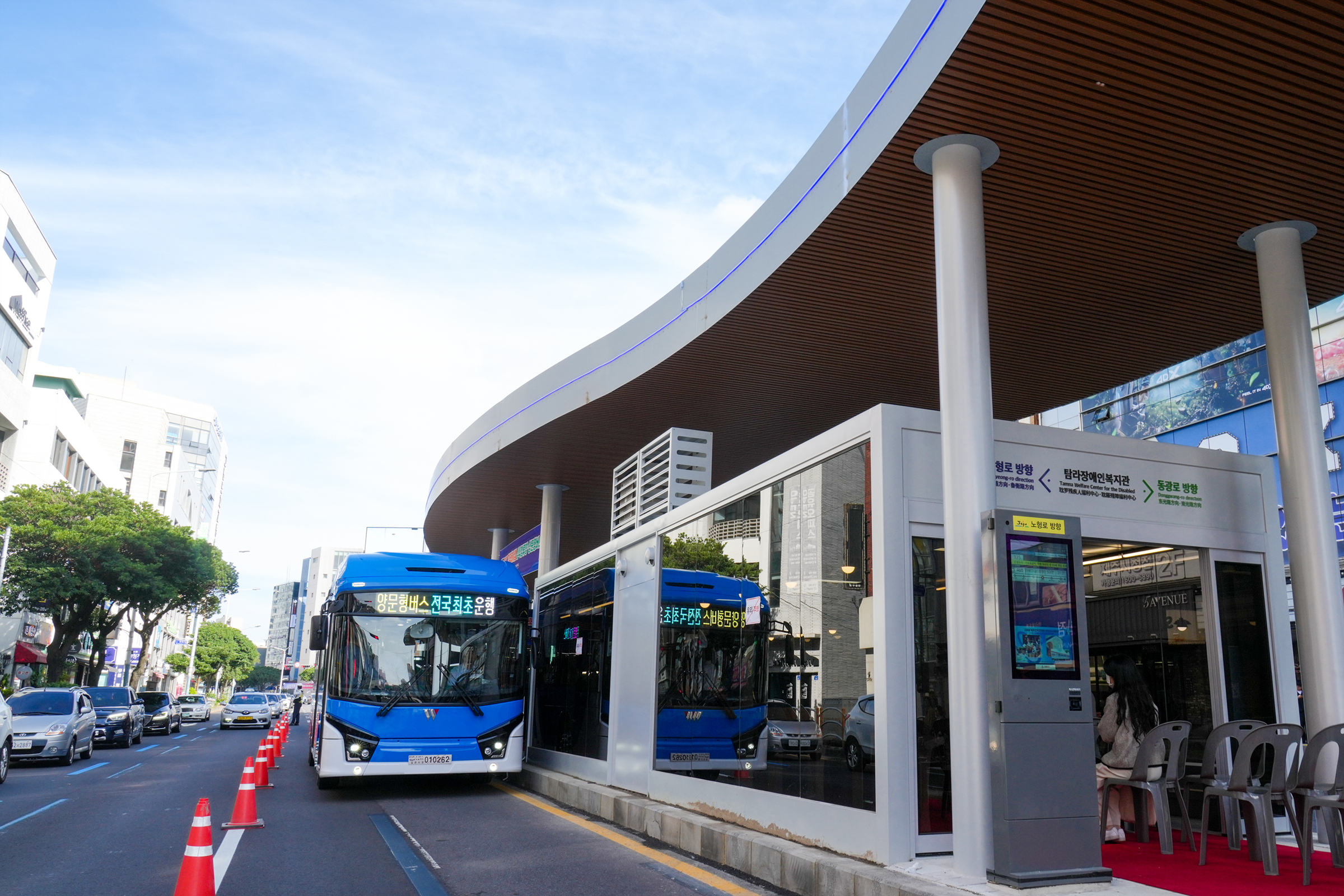
Featured photo: A Jeju City island bus stop and local bus; not a photograph of every route in this guide. Photo by Jeju Special Self-Governing Province, Public Transport Division (source), KOGL Type 1. Resized for display.
Can you travel Jeju Island without a car? Yes. A rental car makes some routes faster, but it is absolutely possible to enjoy Jeju using buses, taxis and carefully planned day routes. The key is to organize each day by area instead of crossing the island repeatedly.
This guide is designed for international visitors who want a realistic, low-stress way to explore Jeju without driving.
Quick answer: is Jeju without a car realistic?
Yes, especially if you stay near a major transport hub, group attractions by region and allow more travel time than you would with a rental car. Jeju has no subway system, so buses are the backbone of public transportation. Taxis are useful for short gaps between bus stops and attractions, and organized day tours can make remote areas much easier.
If your priority is maximum flexibility, sunrise stops or several remote attractions in one day, a rental car is still the easiest choice. If you prefer not to drive, however, a bus-and-taxi combination works well for most first-time itineraries.
Best places to stay without a car
Jeju City
Jeju City is the easiest base for airport access, major bus connections, Dongmun Market and northern Jeju. It is a strong choice for short trips, late arrivals and early departures.
Seogwipo
Seogwipo is a better base if you want waterfalls, the southern coast, Jungmun and easier access to many southern attractions. Travelers staying four or five nights may find it useful to split their stay between Jeju City and Seogwipo.
Should you stay in Aewol or Seongsan without a car?
You can, but these areas are less flexible as a single base for the whole island. Aewol works well for western Jeju, while Seongsan is ideal for Seongsan Ilchulbong and Udo. For a first car-free trip, Jeju City or Seogwipo is usually simpler.
See our Jeju accommodation guide for area-by-area advice.
How Jeju buses work
Jeju buses connect the airport, cities, towns and many popular attractions. Routes vary from frequent urban services to longer intercity and tourist-oriented services, so the best approach is to check each route on the day of travel.
For real-time planning, Korean map apps are more useful than relying on a fixed printed timetable. Visit Jeju specifically recommends using services such as Kakao Map for route searching and live bus information.
Useful bus-planning habits
- Check the next two departure options before leaving an attraction.
- Save the Korean name of your destination in your phone.
- Allow extra time for transfers in rural areas.
- Do not schedule the last attraction of the day too tightly around the final bus.
- Group nearby places instead of trying to cross east-to-west in one day.
Airport to Seogwipo without a car
One of the easiest public-transport routes for visitors is the airport limousine bus to the Jungmun and Seogwipo area. Jeju International Airport currently lists limousine bus 600 from the airport toward Jungmun and Seogwipo. The airport guide lists the first departure at 06:00 and the last at 22:40, with intervals that can vary, so check the official schedule before you travel.
See all Jeju transportation guides.
Bus vs taxi vs day tour
Bus
Best for: budget travelers, solo travelers and people with flexible schedules.
Pros: inexpensive, broad network and no need to drive.
Cons: longer travel times and more waiting in rural areas.
Taxi
Best for: short transfers, rainy days, luggage and filling gaps between bus routes.
Pros: direct and simple.
Cons: repeated long rides can become expensive.
Day tour
Best for: travelers who want to see several remote attractions in one day without planning transfers.
Pros: efficient route and less navigation stress.
Cons: fixed schedule and less independence.
A realistic 3-day car-free Jeju plan
Day 1: Jeju City and the north
Keep your first day simple, especially if you arrive by plane. Explore Dongmun Market, the old downtown area, Yongduam or a nearby coastal area. This reduces the risk of losing half a day to long transfers immediately after arrival.
Day 2: East Jeju
Focus on one eastern cluster. A practical combination can include Seongsan Ilchulbong and nearby coastal sights. If you plan to visit Udo, treat the ferry as the main event of the day rather than adding too many distant stops.
Day 3: South Jeju
Move toward Seogwipo, Jungmun or a southern attraction cluster. Choose two or three major stops rather than trying to cover every waterfall and museum.
For longer trips, add a separate western Jeju day instead of mixing the east and west coasts together.
Best areas to explore without a car
Jeju City: easiest for airport access, markets and urban transport.
Seogwipo: strong base for the south coast and several major attractions.
Seongsan: good for sunrise peak, eastern coast and Udo access.
Hamdeok: popular beach area with relatively straightforward access from Jeju City.
Jungmun: convenient for resorts, museums and southern attractions.
Places that need more planning
Remote oreum, rural cafes and small coastal viewpoints may require an infrequent bus plus a walk or taxi. These are not impossible without a car, but they should be planned as one or two focused stops rather than part of a crowded itinerary.
Useful apps for a car-free Jeju trip
- Kakao Map: useful for bus routes, stops and live location information.
- Naver Map: another useful option for Korean public transport and place searches.
- Translation app: useful for addresses, menus and short conversations.
- Weather app: essential because wind and rain can change outdoor plans quickly.
Common mistakes to avoid
- Trying to see the entire island in one day. Jeju is larger than many first-time visitors expect.
- Booking accommodation only for the view. Without a car, a beautiful remote hotel can create daily transport problems.
- Ignoring the last bus. Rural services may end earlier than expected.
- Planning exact minute-by-minute transfers. Build in buffer time.
- Using only international map apps. Korean map services often provide more useful local transit information.
Local Jeju tip
The simplest rule is: one region per day. East, west, south and Jeju City should be treated as separate travel zones. This makes a car-free trip much more enjoyable and reduces unnecessary transfers.
Who should rent a car instead?
You should seriously consider a rental car if you want to visit multiple rural oreum, remote cafes, sunrise or sunset points far from major roads, or if you are traveling with young children and a lot of luggage. Driving also helps in poor weather when waiting outside for buses is less comfortable.
Final verdict
A car is convenient in Jeju, but it is not required. First-time visitors can have an excellent trip using buses, taxis and carefully grouped routes. Choose the right base, avoid crossing the island repeatedly and keep each day focused on one area.
Next, plan your route with our Jeju itineraries, things to do in Jeju and where to stay in Jeju.
Official sources
- Jeju International Airport – Public Transportation
- Jeju Bus Information System
- Visit Jeju – Official Tourism Information
Last reviewed: September 2026. Bus routes and operating times can change, so confirm same-day information before departure.